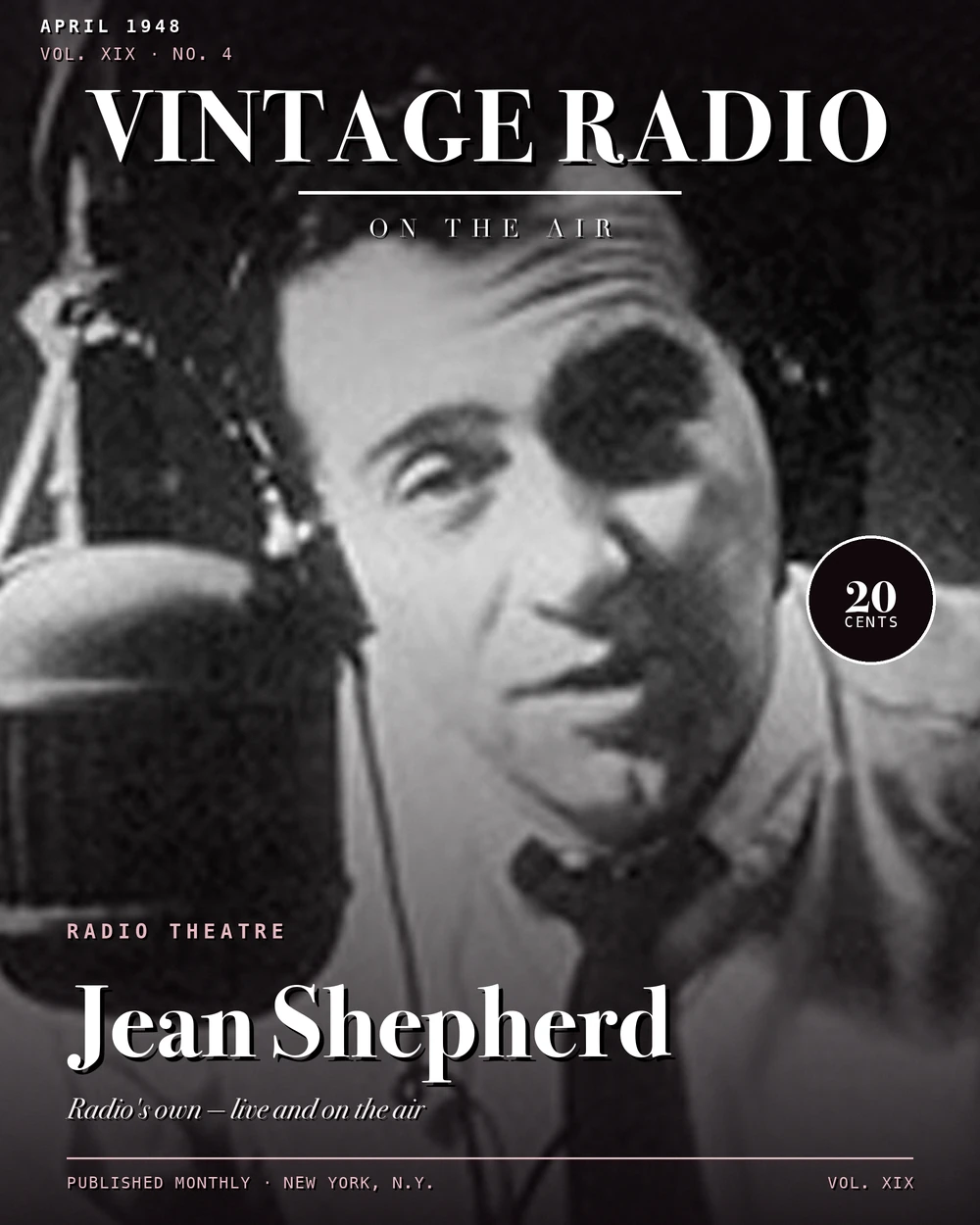
Jean Shepherd
The Man Who Invented a New Kind of Radio
Jean Shepherd didn't play records, read the news, or follow a script. What he did, night after night on WOR in New York City, was talk — and the talking was unlike anything else on the dial. Beginning February 26, 1955, his late-night show became a nightly improvised monologue, a one-man performance that Marshall McLuhan, writing in Understanding Media, described as "a new medium for a new kind of novel that he writes nightly." That's a remarkable thing to say about a radio program, and it points at what made Shepherd genuinely hard to categorize. He wasn't a comedian doing bits. He wasn't a talk-show host swapping opinions. He was a storyteller, finding the comedy buried in the ordinary details of growing up, going to school, getting cold, and wanting things you couldn't quite have.
Jean Parker Shepherd Jr. was born July 26, 1921, on the South Side of Chicago and raised in Hammond, Indiana. He served in the U.S. Army Signal Corps from 1942 to 1944, and after his discharge he started his broadcast career in early 1945 on WJOB in Hammond. What followed was a restless circuit through Cincinnati — WSAI, WCKY, and WKRC — where he was reportedly fired repeatedly for talking too much and playing too little music. There was a late-night run on KYW in Philadelphia from 1951 to 1953. By the time he landed at WOR, he had been too much himself for every room he'd been in, which was probably exactly what the right room needed.
How the WOR Show Worked
The WOR program ran nightly, and from 1961 to 1977 a 45-minute version aired each night — in the 1960s and 1970s from 11:15 pm to midnight, later shifted to 10:15 to 11 pm. The format, if you could call it that, was almost entirely extemporaneous. His WOR colleague Barry Farber marveled at how Shepherd could talk for so long with so few notes. There was no stack of index cards, no outline waiting in a drawer. There was a theme, announced at the open with the "Bahn Frei Polka" by Eduard Strauss and a U.S. Cavalry Bugle First Call, and then Shepherd was on his own.
The audience he built was intensely loyal. He called them his "night people," a phrase that entered the Dictionary of American Slang with credit given to Shepherd, circa 1956. These were the listeners who stayed up late, who felt like they were in on something. For several years on Saturday nights, Shepherd broadcast live from the Limelight Café in Greenwich Village, and the show aired regularly on KRAB-FM Seattle between 1964 and 1976. The community around the program was real — real enough that in 1956 Shepherd organized what became known as the "I, Libertine" hoax, directing his listeners to walk into bookstores and ask for a novel that didn't exist. The resulting confusion was significant enough that publisher Ian Ballantine took notice, and ultimately had Shepherd, author Theodore Sturgeon, and illustrator Frank Kelly Freas produce the actual book.
The Stories He Told
The material Shepherd returned to most often was his Indiana childhood — the cold winters, the neighborhood characters, the gap between how adults imagined childhood and how it actually felt from inside it. Humor in the mundane was his specialty: the embarrassment of wanting the wrong thing for Christmas, the social mechanics of a Boy Scout troop, the rituals of summer and fireworks. On Fourth of July broadcasts, he would read his recurring story "Ludlow Kissel and the Dago Bomb that Struck Back," timed to sync with local fireworks displays. That kind of thing — the joke landing exactly with the boom outside your window — was something only radio could do.
Some broadcasts ventured into territory beyond nostalgia. One program recounted Shepherd's own participation in the March on Washington in August 1963, the occasion of Martin Luther King Jr.'s "I Have a Dream" speech. Another, aired on November 25, 1963, covered the burial of President John F. Kennedy. These weren't typical subjects for a late-night comedy program, but they were entirely consistent with Shepherd's approach: get close to an experience, describe what it actually felt like, and trust the audience to follow.
The surviving episode titles give a sense of the range — "Inventions and Myths," "Scientific Proof," "Obsolete People," "Boy Scout Santa Claus," "Lost At C," "Christmas Pipe." The catalog holds 25 episodes spanning June 16, 1957 through December 14, 1976, a slice across nearly twenty years of a program that ran until Shepherd's final WOR broadcast on April 1, 1977.
The Musical Dimension
Shepherd had a musical streak that surfaced in unexpected ways. His shows sometimes included kazoo solos. His first known recording was a 1955 Abbott Records album that mixed his commentary with jazz pieces, and he collaborated musically with Charles Mingus. The "Bahn Frei Polka" as a theme tune was itself a small joke — a cheerful, charging piece of Eduard Strauss used to introduce a man who was about to sit still and tell you a story for 45 minutes.
His relationship with print ran parallel to radio throughout his career. He contributed more than two dozen stories to Playboy between 1964 and 1981. His books include In God We Trust, All Others Pay Cash (1966), Wanda Hickey's Night of Golden Memories and Other Disasters (1971), The Ferrari in the Bedroom (1972), and A Fistful of Fig Newtons (1981). The oral quality of his radio work carried directly into the writing — these were stories that read like someone talking, which made sense, because many of them started as someone talking.
Beyond Radio: Film and Television
The work Shepherd is probably best remembered for today is the 1983 MGM film A Christmas Story, which he wrote and narrated. Directed by Bob Clark and co-written from his semi-autobiographical book In God We Trust, All Others Pay Cash, the film drew directly from the childhood material that had been central to his radio work for decades. The nine-year-old kid wanting a Red Ryder BB gun, the old man and his leg lamp, the frozen flagpole — all of it came out of Hammond, Indiana by way of twenty-plus years of late-night radio storytelling. The film is now considered a holiday classic, which is an odd fate for material that was never particularly sentimental.
Shepherd also wrote and narrated the PBS television series Jean Shepherd's America, produced by WGBH Boston, and later produced Shepherd's Pie for the New Jersey Network. He wrote several American Playhouse teleplays, including The Phantom of the Open Hearth and Ollie Hopnoodle's Haven of Bliss. After his final WOR broadcast, he did shorter radio work — segments on WCBS and occasional commentaries on NPR's All Things Considered. He was inducted into the Broadcast Pioneers of Philadelphia's Hall of Fame on November 22, 2013. He died on October 16, 1999.
What He Left Behind
The influence Shepherd had on comedy and storytelling is traceable in specific ways. His oral narrative style is identified as a precursor to the work of Spalding Gray and Garrison Keillor. Jerry Seinfeld has stated directly: "He really formed my entire comedic sensibility – I learned how to do comedy from Jean Shepherd." Seinfeld named his third child Shepherd in his honor.
Eugene B. Bergmann's 2005 book Excelsior, You Fathead! The Art and Enigma of Jean Shepherd documents his life and career through interviews with 32 people who knew or were influenced by him, alongside hundreds of broadcast tape recordings. The book's title comes from Shepherd's own sign-off phrase, which tells you something about the tone he maintained — enthusiastic but self-aware, celebratory without being sentimental. That combination is rarer than it sounds, and he kept it going for more than two decades of nightly radio. Some people are cited as having invented free-form talk radio; Shepherd is one of the more credible candidates for that claim.